Prepare for Your
NY Road Test
The scoring guide, right-of-way, parallel parking, and the 3-point turn — all in one place. No downloads, just scroll.
Road Test Scoring Guide
See exactly what the examiner checks off, point by point.
Scoring at a Glance
A Serious Violation, a Dangerous Action, or an Accident is an automatic fail — no matter your point total.
Before Your Road Test
- Supervised practice: if you're under 18, at least 50 hours, including 15 hours after dark.
- Pre-licensing course: required before you can schedule your test (MV-278 or MV-285).
- Your car: must be registered, insured, inspected, and in good working order.
- Bring with you: your photo learner permit, your course certificate, and — if you're under 18 — your Certification of Supervised Driving (MV-262).
During Your Road Test
- Seat belts: everyone in the car must wear one.
- Speed: obey the limit, adjust for conditions.
- Observation: keep checking your mirrors, blind spots, and intersections.
- Signals: use them at least 100 feet before you turn or change lanes.
- Right-of-way: yield to pedestrians, emergency vehicles, and other traffic when required.
After Your Road Test
- If you pass: you'll get an interim license online — keep it with your permit until your photo license arrives.
- If you fail: you can retake the test (a waiting period may apply).
Point Deductions by Category
A) Leaving the Curb
- Fails to observeCheck mirrors, blind spots, and traffic before moving.−10 pts
- Fails to signal−5 pts
- Mirror only, no head checkAlways turn your head to check blind spots.−5 pts
B) Turning & Intersections
- Poor judgment at intersectionsApproach with caution, obey signs/signals, yield appropriately.−10 pts
- Fails to stop near center when waiting to turn left−10 pts
- Turns wide (right)−5 pts
- Turns wide (left)−5 pts
- Inattentive to signs, signals, or lane markingsStay in the correct lane, obey all traffic control devices.−10 pts
C) Parking, Backing & U-Turn
- Fails to signal−5 pts
- Fails to observe/use cautionLook back and around while backing up.−10 pts
- Unable to park properlyWheels within 1 ft of the curb.−15 pts
- Unable to make a 3-point turnSmooth, no hitting the curb or crossing the center line.−15 pts
- Excessive space from curb−5 pts
- Excessive maneuvers−5 pts
D) Driving in Traffic
- Fails to keep rightKeep right except to pass on multi-lane roads.−10 pts
- Improper lane use−10 pts
- Follows too closelyKeep at least a 2-second following distance.−10 pts
- Excessive speed for conditionsAdjust speed for traffic, weather, and road conditions.−15 pts
- Too slow / impedes traffic−5 pts
- Fails to yield right-of-way−15 pts
- Poor judgment in traffic−10 pts
- Fails to signal/observe when changing lanes−10 pts
- Fails to anticipate pedestrians/others−10 pts
- Fails to anticipate hazardsScan ahead, be prepared for unexpected actions.−10 pts
E) Vehicle Control
- Repeated stallingPractice smooth clutch/brake coordination.−10 pts
- Poor engine control/acceleration−10 pts
- Poor steering controlKeep both hands on the wheel, steer smoothly.−15 pts
- Delayed/abrupt brakingBrake early and gently.−10 pts
- Poor use of gears−10 pts
- Poor clutch control−5 pts
- Poor reactions to emergencies−10 pts
Right-of-Way, Made Simple
Who goes first? Here are the rules, in plain English.
Already in the intersection? You go first.
If a car is already in the intersection, you must wait — even if your light is green.
Turning left? Yield to oncoming traffic.
If you're turning left, let cars going straight or turning right from the other direction go first.
No signs or signals? Yield to the driver on your right.
If two cars stop at the same time with no stop sign or light, whoever is on the right goes first.
Pulling out of a driveway or parking lot? You always yield.
Cars and people already on the street or sidewalk always have the right-of-way over you.
Always yield to pedestrians.
Whether the crosswalk is painted or not, people crossing the street always go first.
Don't enter unless you can get all the way through.
If traffic is backed up ahead, wait — never block the intersection.
Entering a traffic circle? Yield to cars already in it.
Cars already driving around the circle always have the right-of-way over cars entering.
5 Steps to Parallel Park
The exact step-by-step the examiner wants to see.
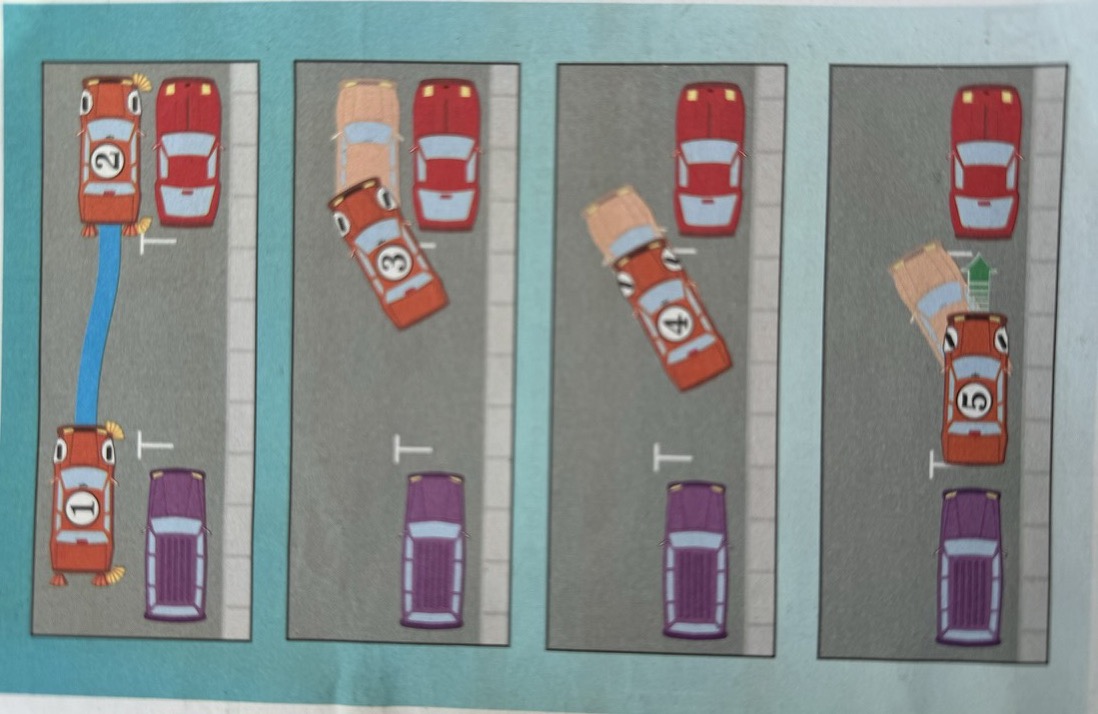
Pick your spot and pull up alongside it
Check your mirrors, signal, and stop next to the car in front of the space — leave about two feet between your car and theirs.
Look, then back up and turn
Look over both shoulders to make sure it's clear. Back up slowly and turn the wheel all the way toward the curb. Look through your rear window, not the mirrors, checking front and sides occasionally.
Straighten out as you clear the car ahead
When your front wheels are opposite that car's back bumper, turn the wheel the other way while you keep backing up. Make sure you clear it, and stop before you bump the car behind you.
Straighten your wheels and pull forward
Leave room front and back. Your final position should have your wheels no more than one foot (30 cm) from the curb.
How to Do a 3-Point Turn
Used to turn around on a narrow, two-way street. You may be asked to do one on your road test.
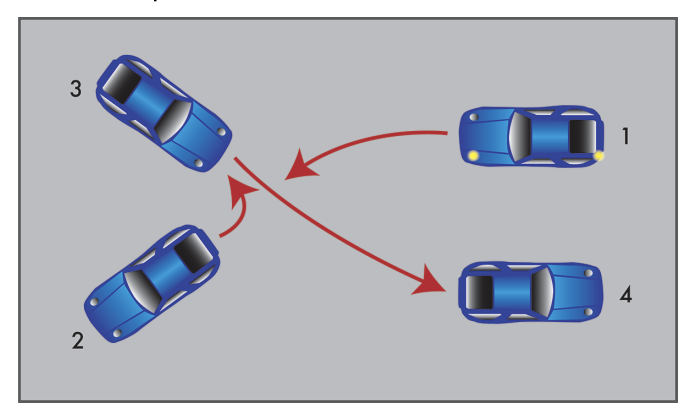
Signal and pull over
Signal right, then pull over to the right and stop. Signal left, then check carefully for traffic from all directions.
Turn left across the road
Turn left and go across the road so you come to a stop while facing the left curb or edge of the road.
Back up to the right
Look again for traffic. Turn your steering wheel as far to the right as possible, then look behind you as you back up. Stop before you reach the right curb or any obstacle.
Check again, then pull forward
Stop, check again for traffic, then turn your wheel all the way to the left and pull forward to complete the turn when it's safe.
Turns
Always signal before you turn or change lanes — at least 100 feet ahead.
Keep your wheels straight until you actually turn
If your wheels are already turned and you're hit from behind, your car could be pushed into oncoming traffic.
Watch for people who are easy to miss
Motorcycles, bicyclists, pedestrians, wheelchairs, strollers — take extra caution on right turns, where they're hardest to see.
Slow down and stay alert on all sides
Reduce your speed as you approach the turn, and check for traffic all around you before you commit to it.
Sharing the Road
Pedestrians and bicyclists always need extra caution.
Watch for pedestrians everywhere
Especially near schools, bus stops, and crosswalks — marked or not.
Always yield to a cane or guide dog
A blind pedestrian always has the right-of-way, even outside a crosswalk.
Check twice before you move
Look over your shoulder and check mirrors before backing up, turning, or opening your door.
Give bicyclists room
Check your blind spot before you turn, park, or open a door near one.
Never block a crosswalk, sidewalk, or bike lane
Stop well back so people and cyclists can pass safely.
Want to practice all of this with an instructor before your test? We'll walk you through it in person.